
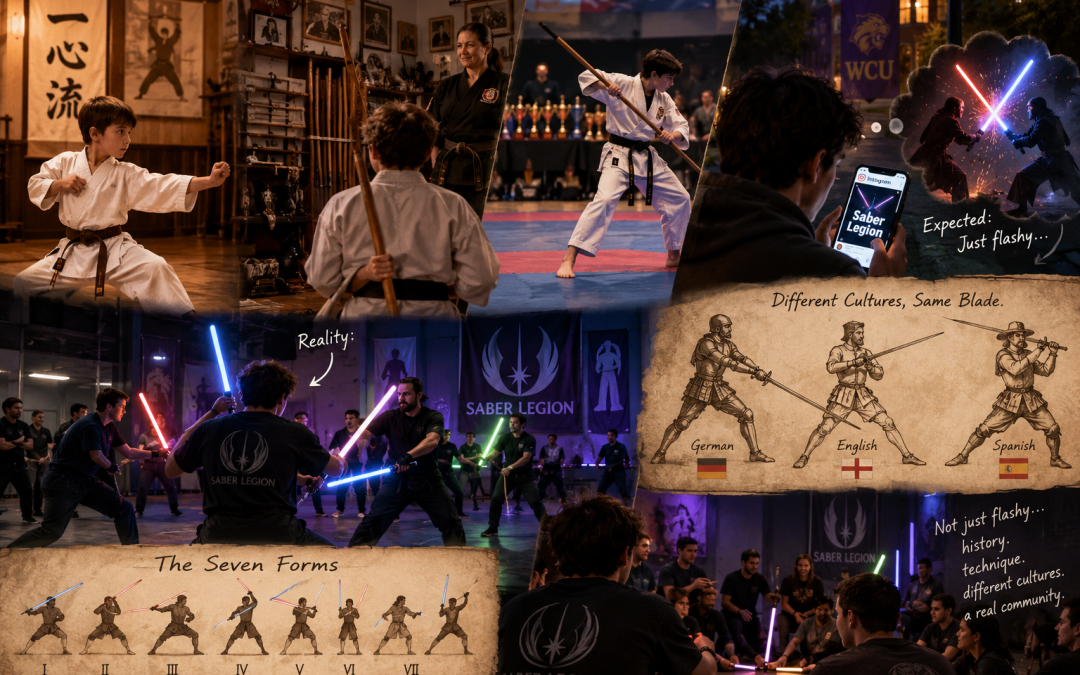
Before I came to WCU, I had a community of martial artists at the dojo I had been attending since third grade. Our main practice was Isshinryu Karate. I’ve always been a nerd, and I absolutely LOVE Star Wars, so martial arts and nerdy interests have always been a big part of who I am. The owner of the dojo, Sensei Erica, has a vast knowledge of eight or nine different martial arts. She has earned black belts in four of them and holds a Sensei title/rank in three. Because of this, our dojo is filled with fun things and pieces of historical significance connected to our Sensei and their experiences.
One day, I decided to start learning Kobudo just for fun. Eventually, this led to me performing Kobudo in competitions. Since most competitions don’t charge an additional fee for participating in multiple divisions if you already paid the application fee, I figured I might as well compete in as many divisions as I could. What started as something I was simply learning for fun eventually became something I enjoyed performing and competing in.
Coming to WCU, I heard about the Saber Legion through Instagram. I knew that in Star Wars there was a system used to distinguish different styles of fighting, but in the movies and shows, there are a lot of inaccurate moves that are more flashy than anything else. This is common in most sci-fi media because they add special elements to fighting to make it more entertaining. Because of that, I expected the Saber Legion to be mostly flashy movements and choreographed fights. I was wrong.
I learned from my first meeting that they actually have a clash of different cultures that comes together to create what they call “Lightsaber Dueling.” They use what are called “Forms.” Normally, the word “Forms” can refer to a type of open-hand combat routine that is almost like a dance. In my martial art, we called them “Katas.” The “Forms” in the Saber Legion are different. Instead of being one long, memorized dance, they are more like a set of movements and techniques that can give you different advantages depending on your footwork, coordination, distance, and how you react to your opponent’s movements.
Just like how the martial art I learned was a Japanese art with heavy traditional Okinawan elements, the sword fighters in the Saber Legion use techniques influenced by different cultures. German, English, and Spanish sword fighting traditions all have their own histories and techniques, and the club adapts elements from them into their dueling system. The Star Wars Forms are numbered one through seven, and each of them has real-life martial arts or sword-fighting influences behind what they do.
Because of this, I was extremely wrong about what I thought the club would be like. It was not nearly as flashy or simple as I expected. Instead, there is a lot more history, technique, and thought behind the fighting. I’ve really enjoyed the time I’ve spent with the community so far, and it has been interesting to see something I already enjoy, Star Wars, combined with something I have practiced for most of my life, martial arts.
Thank you
-Landen Goetz
About The AI
The experience of creating an AI image for me was thoughtless. I typed a few words and got a result in a couple of seconds. I did almost nothing to get the result, but the AI was able to pull from information it had access to, which is something I could have done myself. This gave me a filler and a point on an assignment, so I guess that is the trade-off here. The image took the Catamount logo and understood that the story indicated Western Carolina University and not West Chester University, which I found interesting. That gives me the idea that the basic GPT, which is what I used, has been fed a lot of information about our school. It was good that it did not create misinformation by leading the reader to assume I went to another college.
The prompt was very simple: “Create an image based on this story.” The AI got the hands wrong. Most of them weren’t actually gripping the sword hilts and instead looked like they were fused with the swords. The Bo that little me was holding in the top middle was also on the wrong side of my body. The AI got my Sensei’s face, hair, and dojo logo alarmingly correct, considering I didn’t mention any of those things in the prompt and only included her name.
I think the disadvantages of AI start with simply using it. If you showed up to a conference call with a PowerPoint full of cartoon characters, I would probably laugh, and I believe most people would as well. People on social media platforms have used AI to make jokes almost since its conception, such as the Will Smith eating spaghetti video, so the obvious use of AI can come across as unprofessional. This becomes more complicated when considering that some educational institutions have started restricting or banning AI use for teachers and students. This creates a line between artificial intelligence and the work people are expected to produce themselves. The discussion goes even further when considering the debates surrounding government regulation of AI research and its use in the workplace.
My personal opinion is that I would not use AI imagery in an assignment for an employer or any firm unless I was specifically employed for the purpose of using AI to create an image. On that note, my final prompt was: “Fix the hands.” The result was the following:
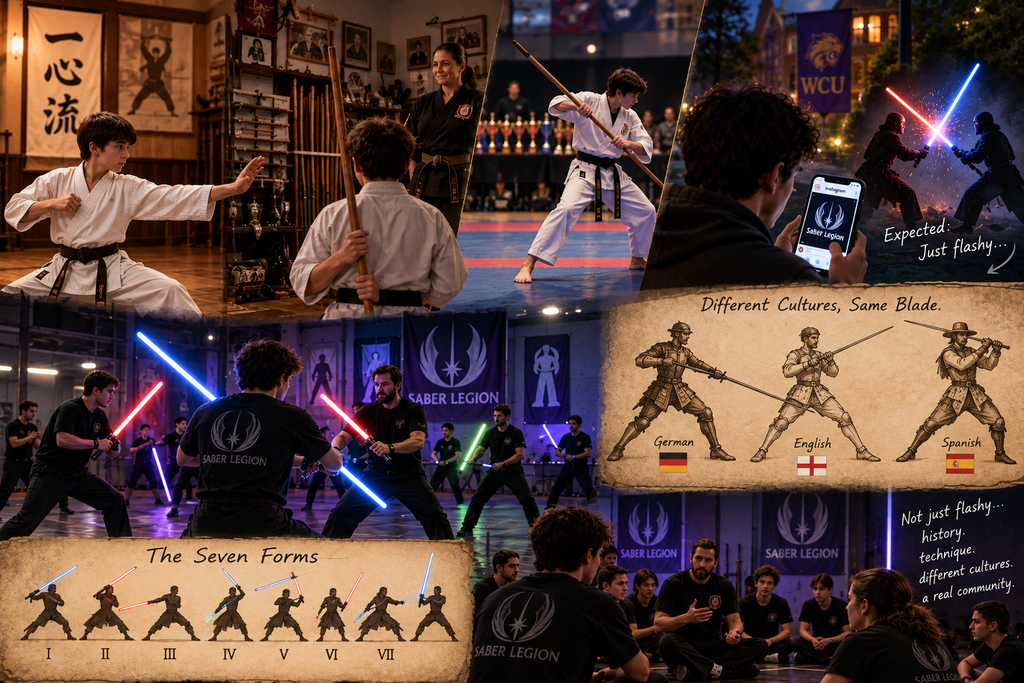
It fixed the majority of the problems, but it still couldn’t fix the most obvious one with the Bo. I can see the appeal of using AI for something like this because it takes almost no time and can produce something usable within seconds. At the same time, I can also understand why someone would choose not to use it in their job. There is something to be said for the time, effort, and dedication that goes into creating something yourself instead of having AI do most of the work for you.
I like how all the photos are visually appealing to look at and are just overall cool. nice
Hi Landen! I enjoyed your post about the Catamount Saber Legion. I liked how you described expecting flashy, choreographed fights and then finding out the club draws on real German, English, and Spanish sword-fighting traditions. Your karate and Kobudo background gave you a good way to compare the “Forms” with the katas you already knew.
Your reflection on the AI image was the part I found most interesting. You said it felt thoughtless, since you typed a few words and had a result in seconds, and I think that’s an honest take. But you still noticed a lot of detail in the output. It understood from your story that you meant Western Carolina University and not West Chester University, and it got your Sensei’s face, hair, and dojo logo right even though you only gave her name. That surprised me too, and it made me think about how much the AI seems to know about specific people and places.
I also liked that your prompt change was very simple. “Fix the hands” solved most of the problem, but the Bo was still on the wrong side. That shows the AI can follow a short correction but can still miss details that matter to the person who was there, because you were the one who knew what the scene should look like.
I agree with your point that using AI can come across as unprofessional in some settings, like a conference call with cartoon characters. Your point about schools restricting AI use also made me think about how different organizations treat it. Would you feel differently if the image was only a small supporting piece in a presentation and not the main part of it?
I like how you included the image with the mistakes. I feel like it shows people that AI is not perfect.
I liked how you connected your experience with martial arts to Star Wars and the Saber Legion. It was also interesting to hear how your expectations were completely different from what you actually experienced.
Liked how you connected martial arts with Star Wars. It’s cool that you found a group that mixes both discipline and creativity. Your Blog shows how passion can build community.
I really liked the connection you made between the Saber Legion and your background in martial arts. I had no idea that lightsaber dueling pulled from real German, English, and Spanish sword-fighting traditions. I also thought your point about how little effort it took to generate the AI image was interesting, especially compared with the amount of time that goes into creating something yourself.
The visual of the three cultures are very impressive and the many different forms are very nice and interesting
It is quite interesting how the AI was able to get certain things right, but fail to create the simple things. I barely notice that when using Ai so this was an interesting blog to create especially when real life pictures could be used from the Saber Club. I like it anyways!